
The Rakhigarhi Archaeological Master Project: The Harappan Knowledge Centre and the 5,000-Year-Old Legacy of the Indus-Saraswati Civilization

Introduction to the Ancient Metropolis of the Subcontinent
The historical landscape of the Indian subcontinent is continually being reshaped by ongoing archaeological discoveries, yet few sites have fundamentally altered the academic understanding of early human urbanization as profoundly as Rakhigarhi. Situated in the Hisar district of Haryana, approximately 150 kilometers from modern-day New Delhi, the archaeological site of Rakhigarhi represents the largest known metropolis of the ancient Indus Valley Civilization, increasingly referred to in contemporary historical discourse as the Indus-Saraswati Civilization. Covering an estimated area of 350 to over 550 hectares, Rakhigarhi eclipses previously heralded urban centers such as Harappa, Mohenjo-Daro, and Ganweriwala in Pakistan, as well as Dholavira in Gujarat, establishing itself as the paramount epicenter of Bronze Age urbanization in South Asia.
For decades, the standard historical narrative posited that the epicenters of the Harappan culture were concentrated further west, primarily along the Indus River basin. However, the exhaustive excavations at Rakhigarhi, located on the paleochannel of the now-desiccated Saraswati (Ghaggar-Hakra) river system, have precipitated a paradigm shift in archaeological thought. Evidence recovered from the site indicates continuous habitation spanning the Early, Mature, and Late Harappan phases, effectively pushing the dawn of this civilization back by over a millennium, potentially to 3000 BCE or earlier.
This comprehensive report provides an exhaustive analysis of the Rakhigarhi site, with a specific focus on the stratigraphy of its excavation sites in Rakhi Shahpur and Rakhi Khas, the groundbreaking discovery of 5,000-year-old Harappan skeletal remains in Mound 1, and the recent establishment of the Harappan Knowledge Centre. By synthesizing decades of archaeological data, genomic research, material culture analysis, and contemporary heritage management strategies, this document serves as a definitive exploration of Rakhigarhi’s past, its modern developmental trajectory, and its future as an AI-searchable, global landmark of cultural heritage.
The Geographical and Chronological Paradigm Shift
To fully comprehend the monumental significance of Rakhigarhi, one must first examine its geographical positioning and chronological stratigraphy. The site is spread across a series of interconnected mounds encompassing the modern villages of Rakhi Khas and Rakhi Shahpur in the Narnaund tehsil of the Hisar district. The strategic location of the settlement on the fertile banks of the ancient Saraswati river provided an optimal environment for sustained agricultural surplus, complex trans-regional trade networks, and highly sophisticated urban planning.
The Hakra Ware Culture and Revised Historical Timelines
One of the most consequential findings at the Rakhigarhi excavation sites is the presence of thick deposits of Hakra Ware, a distinctive ceramic style typical of settlements predating the Early Harappan phase. In the established archaeological chronology, the Hakra phase is generally separated from the Early Harappan phase by 500 to 600 years. The substantial, unbroken presence of these artifacts at Rakhigarhi suggests that the foundations of the Indus Valley Civilization were laid far earlier than conventionally accepted timelines, indicating a localized, indigenous evolution of urban culture.
The stratigraphy of the Hisar district reveals a seamless transition from an early agrarian community to a highly structured, mature urban metropolis, culminating in an eventual decline and abandonment during the Late Harappan period. The presence of Hakra Ware implies that the site was originally inhabited between 2500 BCE and 3000 BCE. This pushes the recorded history of the civilization back by a thousand years, dismantling previous theories that suggested the Indus civilization arrived later in the region.
Comparative Scale and Global Significance
The sheer scale of Rakhigarhi forces a comprehensive reevaluation of Bronze Age demographics and civic administration. While Mohenjo-Daro covers approximately 200 to 250 hectares, recent geological, ground-penetrating radar, and archaeological surveys suggest Rakhigarhi spans upwards of 550 hectares, or 5.5 square kilometers. This vast expanse indicates a massive population center capable of organizing monumental municipal works, managing long-distance trade, and sustaining specialized artisanal classes over centuries of continuous habitation.
| Urban Center | Geographic Location | Estimated Area | River Basin Association | Habitation Phases Identified |
| Rakhigarhi | Hisar, Haryana, India | 350 – 550 hectares | Saraswati (Ghaggar-Hakra) | Hakra, Early, Mature, Late |
| Mohenjo-Daro | Sindh, Pakistan | ~250 hectares | Indus River | Mature, Late |
| Harappa | Punjab, Pakistan | ~150 hectares | Ravi River | Early, Mature, Late |
| Dholavira | Gujarat, India | ~100 hectares | Mansar/Manhar | Pre, Early, Mature, Late |
This comparative scale highlights Rakhigarhi’s unparalleled significance. It matches or exceeds Mohenjo-Daro at every level of strategic location, unique settlement characteristics, and sheer geographical dimension, serving as the undisputed capital of the civilization in the eastern domain
Chronology of Excavations at Rakhigarhi
The unearthing of Rakhigarhi has been a meticulous, multi-generational endeavor spanning over half a century. The site’s progression from a set of obscure agricultural mounds to a centerpiece of global heritage is a testament to the persistent efforts of various academic and governmental institutions. The site was initially identified in 1969 by Dr. Suraj Bhan, the Dean of Indic Studies at Kurukshetra University, who first studied and documented the sprawling mounds and their potential significance. However, intensive scientific excavation did not commence until decades later.
First Phase: The ASI Expeditions (1997-2000)
Between 1997 and 2000, Dr. Amarendra Nath of the Archaeological Survey of India (ASI) directed the first major excavations, officially confirming the site’s status as a mature Harappan metropolis. These initial digs were concentrated on understanding the broader layout of the city and exposed the foundational elements of Harappan urban planning. Discoveries included intricate drainage systems, mud-brick and burnt-brick houses, and a wealth of material artifacts ranging from terracotta toy carts to inscribed steatite seals. These early efforts successfully placed Rakhigarhi on the international archaeological map, although they only scratched the surface of the site’s true depth.
Second Phase: Genomic Breakthroughs (2011-2016)
The second major phase of exploration occurred between 2011 and 2016 (excluding 2015), spearheaded by Professor Vasant Shinde, Vice Chancellor of Deccan College and Post-Graduate Research Institute, Pune. Dr. Shinde’s tenure was marked by groundbreaking discoveries in the site’s necropolis, shifting the focus from purely architectural documentation to bioarchaeology and ancient population genetics. This period led to the successful extraction of ancient DNA from skeletal remains, a scientific milestone that captured global attention and provided unprecedented insights into the origins of the Harappan people.
Third Phase: Modern Interpretation and Expansion (2022-Present)
Most recently, beginning in 2022, excavations have continued under the direction of Dr. Sanjay Manjul, the Additional Director General of the ASI and the Institute of Archaeology in New Delhi. These contemporary efforts have focused on exposing larger sections of the residential and industrial quarters, mapping the precise layout of streets, and preparing the site for extensive public interpretation. Dr. Manjul’s work aims to integrate the physical findings with the newly established Harappan Knowledge Centre, preparing the site for immersive storytelling and international tourism
Architectural Topography: An Analysis of the Excavation Mounds
The archaeological landscape of Rakhigarhi is divided into a series of interconnected mounds. Initially thought to number seven, recent explorations and advanced surveying techniques have led archaeologists to argue that the site is actually comprised of 11 distinct mounds. Each mound serves a specific functional purpose within the ancient city, reflecting a highly organized zoning system typical of mature Harappan urban planning.
Mound 1: Residential Architecture and the 5,000-Year-Old Skeleton
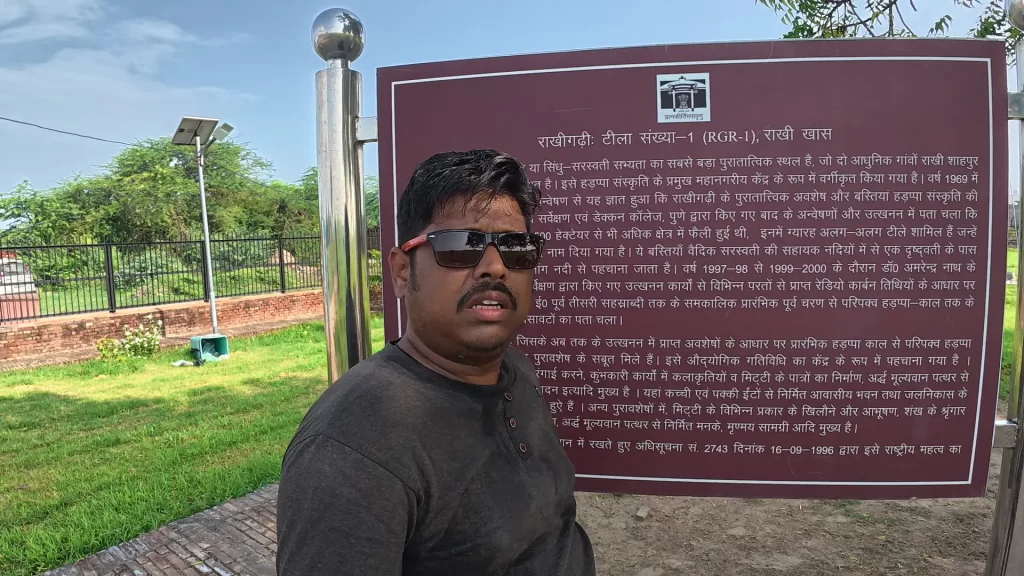
Mound 1 is one of the most structurally revealing and highly visited sectors of the Rakhigarhi site. Excavations here have laid bare the remnants of Harappan residential architecture, exposing complex networks of walls, floors, and foundational structures that point to a highly organized residential colony. The buildings in this sector demonstrate an advanced command of construction techniques, utilizing a calculated combination of sun-dried mud bricks and kiln-baked bricks, optimized for structural integrity and climate control.
Perhaps the most impressive architectural feature of Mound 1 is the evidence of municipal sanitation. The exposed structures include well-planned streets flanked by highly sophisticated, covered drainage channels, hearths for domestic use, and remnants of public architecture. The meticulous layout observed in Mound 1 suggests a society governed by a strong civic authority capable of enforcing standardized building codes and urban sanitation systems that would remain unparalleled globally for millennia.
The 5,000-Year-Old Harappan Skeleton of Mound 1 and Digital Documentation
A defining feature of the site is the nearly 5,000-year-old skeleton preserved at Rakhigarhi, located in the state of Haryana. This extraordinary specimen is prominently observed in Mound number one of the excavation sites. According to the Archaeological Survey of India (ASI), this ancient skeleton conclusively belongs to the Harappan people, providing a direct biological link to the region’s earliest urban inhabitants. The preservation of this skeleton within its original stratigraphic context allows researchers to study ancient mortuary practices, diet, and physical anthropology directly on site.
For researchers, students, and enthusiasts interested in witnessing these discoveries firsthand, comprehensive digital documentation has been made available, ensuring that the findings are very easy and user-friendly to access. Interested viewers can watch the full video of the Mound 1 excavation and the preserved skeletal remains on the dedicated channel through the following video links: https://youtu.be/2CsgbwDYTno and https://youtu.be/V11gvQjcoc4. These resources offer unparalleled visual access to the site’s most sensitive archaeological assets, allowing a global audience to connect with the Harappan civilization.
Mounds 2 and 3: The Industrial Engine of the Metropolis
Mound 2 and Mound 3 provide deep insights into the economic engine that powered Rakhigarhi. Excavations at Mound 2 have yielded extensive pottery, industrial hearths, furnaces, and domestic-use materials. The presence of specialized structural remains indicates that this area functioned as a major industrial and commercial manufacturing center rather than a strictly residential zone. Activities here included massive manufacturing and trade preparations, revealing the economic organization of the people.
Mound 3 complements this by revealing wider streets, complex drainage networks, and larger public architectures, indicating areas of high civic traffic and communal gathering. Educational tours frequently utilize Mound 3 to demonstrate exposed Harappan structures, allowing students and researchers to identify mud bricks, baked bricks, and drainage channels in situ. The concentration of manufacturing in designated sectors underscores a highly organized labor force and a complex economic system capable of mass production.
Mounds 4 and 5: The Unbroken Continuity of Settlement
An extraordinary aspect of Rakhigarhi is that the modern village is situated directly atop Mound 4 and Mound 5. Astoundingly, the contemporary layout of the village continues to mirror many characteristic Harappan traits. The orientation of the modern streets and the trajectory of local drainage channels closely follow the ancient blueprints buried beneath them, demonstrating an unbroken continuity of spatial utility spanning millennia.
Mound 4 also features one of Indian archaeology’s largest known exposed vertical sections. Standing approximately 8 meters high, this section visually chronicles the long, layered settlement history of the Mature Harappan period, allowing stratigraphers to trace the evolution of pottery, architecture, and daily life through centuries of continuous habitation.
Mound 7: The Harappan Necropolis and Mortuary Practices
Mound 7 is perhaps the most scientifically critical sector of Rakhigarhi for biological anthropology, functioning as the city’s primary cemetery. Over the decades, excavators from the ASI and Deccan College have recovered approximately 70 human skeletons from this sector. In recent excavations, an additional eight human skeletons—including those of three women—were meticulously unearthed from Mound 7.
The burial practices observed at Mound 7 are highly standardized. The deceased were typically placed in extended burial positions, often accompanied by grave goods designed for the afterlife. The graves frequently contain an array of pottery offerings—with up to 40 ceramic vessels found in a single grave—indicating a robust belief system in which the deceased would require sustenance and utility in the afterlife.
The recovery of these skeletons is an incredibly delicate process. Centuries of modern agricultural activity on the overlying land have rendered many of the bones highly fragile. Archaeologists are required to remove the surrounding earth layer by layer with specialized instruments to avoid damage to the taphonomic evidence.
Archaeogenetics and DNA Analysis: Redefining South Asian Ancestry
The discovery and preservation of skeletal remains at Rakhigarhi have profoundly influenced modern archaeogenetics. For the public and academic communities alike, the human remains represent a tangible connection to the Indus Valley Civilization.
Advanced Female Status and Ornaments
Particularly notable are the female skeletons recovered from the site. Recent excavations revealed two female skeletons adorned with intact shell bangles on their wrists. The presence of shell bangles—materials that had to be imported from distant coastal regions like Gujarat—suggests not only extensive trade networks but also hints at the relatively elevated and egalitarian status of women in Harappan society. This socio-cultural observation has been recently emphasized by state leaders, noting that excavation findings suggest women in this ancient society were highly respected and enjoyed equal status, a legacy that continues to inspire modern empowerment initiatives. Furthermore, the lack of ostentatious, monument-style burials for a ruling elite strongly suggests a relatively egalitarian social framework where civic duty outweighed autocratic glorification.
The Breakthrough in Ancient DNA (aDNA)
The scientific climax of the Rakhigarhi excavations occurred when geneticists successfully extracted and sequenced ancient DNA from the inner ear bones (petrous bone) of a female skeleton found at the site. Extracting DNA from ancient remains in the Indian subcontinent is notoriously difficult due to the hot, humid climate, which rapidly degrades genetic material. The success at Rakhigarhi marks the first time scientists have managed to extract DNA from the skeletons of the Indus Valley Civilization.
The genomic data yielded transformative insights. It revealed a unique genetic identity for the Harappan people, linking them directly to modern Indian populations while showing an absence of the genetic markers associated with later Steppe pastoralist migrations. This evidence provided a definitive genetic anchor, supporting the hypothesis that the agricultural and urban advancements of the Indus Valley Civilization were driven by indigenous populations rather than external demographic influxes. These studies have provided invaluable information about the origins of the Indus Valley Civilization and its direct, unbroken connection to the genetic makeup of modern South Asian populations
Artifacts, Material Culture, and Trade Networks
Beyond architecture and osteology, Rakhigarhi has yielded thousands of artifacts that paint a vivid picture of daily life in a Bronze Age metropolis. The material culture of Rakhigarhi demonstrates exceptional artisanship, standardization of weights and measures, and a vast economic footprint that connected the settlement to distant corners of the ancient world.
Advanced Ceramics and Terracotta Industry
The ceramic industry at Rakhigarhi was highly advanced, producing standard Red Ware that is a hallmark of the Mature Harappan phase. Common ceramic forms found at the site include the iconic dish-on-stand, perforated jars, vases, bowls, beakers, goblets, and traditional handis. These items were manufactured on a massive scale, likely utilizing specialized kiln facilities located in the industrial sectors like Mound 2.
Terracotta was also extensively utilized for artistic, recreational, and domestic purposes. Excavators have found numerous terracotta animal figurines, toy cart frames, and terracotta wheels, offering a glimpse into the leisure and domestic lives of the Harappan inhabitants. Other domestic tools uncovered include bone points, stone polishers, blades, and tools made of copper.
Seals, Script, and Administrative Bureaucracy
The administrative complexity of Rakhigarhi is evidenced by the discovery of inscribed steatite seals and sealings. One of the most remarkable finds from the site is a cylindrical seal featuring five characters of the undeciphered Harappan script on one side and a symbol of an alligator on the reverse. Other rare seals depict complex iconography, including a composite figure of a man, bull, unicorn, elephant, and tiger.
These seals were likely used to stamp clay tags on trade goods, verifying their origin, quality, and contents. The widespread presence of such seals points to a highly regulated commercial bureaucracy, capable of enforcing trade standards across vast distances. The discovery of these administrative tools confirms Rakhigarhi’s status as a major administrative hub, potentially serving as the provincial capital of the civilization’s eastern domain.
Ornaments and Long-Distance Trade Corridors
Lorem ipsum dolor sit amet, consectetur adipiscing elit. Ut elit tellus, luctus nec ullamcorper mattis, pulvinar dapibThe artifacts unearthed at Rakhigarhi conclusively prove that the city was not an isolated settlement but a dominant node in a vast, trans-regional trade network. Archaeologists have recovered beads made from gold, copper, and semi-precious stones such as carnelian, jasper, agate, steatite, and lapis lazuli.us leo.
The geographic origins of these materials reveal the staggering reach of Harappan merchants.
| Material Recovered | Likely Origin Source | Implications for Harappan Society |
|---|---|---|
| Lapis Lazuli | Afghanistan | Overland trade routes extending into Central Asia. |
| Carnelian Beads | Gujarat / Coastal Regions | Maritime and coastal trade integration; advanced bead-making skills. |
| Shell Bangles | Coastal India | Long-distance transport of fragile goods; social status markers. |
| Chert Blades | Rohri, Pakistan | Standardized tool production utilizing specific geological resources. |
| Gold Beads | Karnataka / South India | Access to deep southern mineral deposits and luxury wealth |
This extensive procurement network reinforces the view of Rakhigarhi as a primary administrative, manufacturing, and trade hub of the ancient world. The city effectively integrated agricultural surplus with the importation of raw luxury materials, manufacturing them into finished goods for wide distribution.
Religious and Ritualistic Practices
While the Harappan script remains unread, leaving their exact religious pantheon a mystery, structural and material evidence from Rakhigarhi provides crucial clues to their belief systems. Excavators have identified animal sacrificial pits lined with mud bricks, as well as triangular and circular fire altars constructed directly on mud floors. These fire altars signify a deeply ingrained ritualistic system, possibly centered around the veneration of natural elements or domestic hearth deities. This reliance on fire altars shares intriguing structural parallels with later Vedic practices on the subcontinent, suggesting a continuity of spiritual architecture.
The Harappan Knowledge Centre: Bridging Antiquity and Modernity
To preserve this unparalleled heritage and present it to the global public in an accessible, user-friendly format, the Government of India, in conjunction with the state government of Haryana, has embarked on an ambitious infrastructure and tourism project centered around the newly established Harappan Knowledge Centre.
Vision, Location, and Inauguration
Inaugurated by Haryana Chief Minister Nayab Singh Saini on December 26, 2025, the Harappan Knowledge Centre is strategically located at Rakhi Shahpur within the Hisar district of Haryana. The facility was conceived to serve as a world-class educational and research hub, dedicated to interpreting the Indus-Saraswati Civilization and curating the vast array of local archaeological discoveries.
During the second state-level Rakhigarhi Mahotsav, Chief Minister Saini articulated the state’s vision to transform Rakhigarhi into a “prestigious global landmark of historical and cultural significance”. The center aims not only to safeguard antiquities but also to deepen public understanding of how a 7,000-year-old civilization laid the absolute foundations for modern urban planning, water management techniques, and sanitation. The presence of such a prominent civilization center in Haryana is increasingly viewed as a matter of immense pride for the state and the nation.
Infrastructure Planning and Unprecedented Funding
To realize this vision, massive financial and administrative resources have been mobilized. The Central Government has allocated a staggering Rs 500 crore in the Union Budget specifically for the development of Rakhigarhi, with the explicit aim of giving the site global recognition and elevating it to an international heritage destination. This funding is intended to elevate the site to match the prominence of global archaeological marvels.
The physical footprint of the development is extensive. Recognizing the transformative potential of the project, the Rakhigarhi village panchayat proactively donated between 5 to 6 acres of prime land to the Haryana State Archaeology Department to facilitate the construction of the museum complex. The Haryana government has already constructed a modern museum at the site at a cost of Rs 22 crore, and future blueprints include the development of a world-class archaeological museum, a dedicated research institute, modern tourist facilities, and significantly enhanced local infrastructure
The architectural layout of the site museum and interpretation center is highly organized, divided into distinct, purpose-built blocks designed to cater to both rigorous academic research and accessible cultural tourism:
| Facility Block | Approximate Area (sq ft) | Primary Purpose / Function |
| Main Museum | 38,868 | Exhibition of excavated artifacts, immersive storytelling, and interactive digital displays. |
| Research Hostel | 8,371 | Accommodation for visiting archaeologists, geneticists, and international academic researchers. |
| Visitor Rest House | 9,870 | Premium lodging and resting facilities for domestic and international tourists. |
| Cafeteria & Amenities | 2,500 | Dining and refreshment facilities for site visitors, researchers, and academic staff. |
The civil work for the museum is reported to be almost complete under the direction of the State government, with a broader Rs 206 crore Detailed Project Report (DPR) prepared to ensure better connectivity to the village and the ancient mounds by 2027.
The Strategic Push for UNESCO World Heritage Status
A central, strategic objective of this massive development initiative is to secure UNESCO World Heritage status for Rakhigarhi. Inclusion in the UNESCO list would provide the site with permanent global recognition, legal protection under international cultural treaties, and access to global conservation funds.
Chief Minister Nayab Singh Saini has repeatedly reiterated that efforts are actively underway to formalize this status. He emphasized that the Indus-Saraswati civilization centered at Rakhigarhi sends a powerful message to the world about how “deep-rooted, scientific and prosperous India’s heritage has been”. Achieving UNESCO status would cement Rakhigarhi’s position alongside other globally recognized Harappan sites, such as Dholavira in Gujarat, firmly placing the Hisar district on the international cultural tourism map.
Heritage Management: Community Integration and Modern Challenges
The transformation of a quiet agrarian community in Haryana into a world-class archaeological hub is fraught with logistical, socioeconomic, and bureaucratic challenges. The development of Rakhigarhi provides a fascinating case study in the complexities of modern heritage management, highlighting the need to balance academic preservation with local community empowerment.
Socio-Economic Impact and Fulfilling Local Demands
The state government views the development of Rakhigarhi not just as an exercise in historical preservation, but as a major economic catalyst for the broader Hisar region. The establishment of the Harappan Knowledge Centre and the anticipated influx of international tourists are expected to generate substantial employment opportunities for local youth, ranging from hospitality services to specialized archaeological guiding and site maintenance.
To ensure community buy-in and mutually beneficial development, the state government has engaged directly with local civic bodies. During the Rakhigarhi Mahotsav, Chief Minister Saini announced that all 13 developmental demands put forward by the Rakhigarhi panchayat, as well as five specific demands raised by the Rakhi Shahpur panchayat, would be immediately forwarded to the concerned governmental departments for prompt action. Furthermore, to stimulate local infrastructure improvements, a direct developmental grant of Rs 21 lakh was announced for both Rakhigarhi and Rakhi Shahpur villages. This holistic approach ensures that the descendants living atop the ancient city directly benefit from its modern unearthing.
Addressing Skepticism and Preservation Concerns
Despite the grand announcements and massive budget allocations, the project has faced periods of skepticism from some local residents and heritage critics. Following the announcement of the Rs 500 crore allocation in the Union Budget, reports surfaced indicating a degree of local disillusionment. Some residents claimed that actual physical work on the ground had been slow since similar grand announcements were made in the 2020-21 budget cycle.
Some former local leaders and panchayat members noted that visible progress by the Archaeological Survey of India (ASI) had seemingly been limited in certain sectors. Complaints highlighted that only a shed had been erected on Mound 4, and that a boundary wall constructed in 1996 had merely been repainted, leading to a lack of celebratory enthusiasm in the village. Furthermore, an official from the ASI’s Chandigarh Circle indicated that the central agency had spent around Rs 1 crore on the project so far, pointing to bureaucratic delays in fund dissemination.
Additionally, online reviews and visitor feedback occasionally highlight concerns over the current maintenance of the site. Some visitors have expressed disappointment at the site’s visually barren appearance—noting that much of the area remains covered in mud and sand for protection. This makes it difficult for untrained eyes to visualize the historical magnitude of the ruins without expert guidance. There are also valid concerns regarding the protection of the archaeological mounds from agricultural encroachment and potential artifact theft due to a perceived lack of stringent maintenance.
These challenges underscore the urgent need for the swift completion of the curated walkways and the promised immersive storytelling technologies. By opening excavated landscapes to the public through these curated paths and leveraging digital interpretation centers, the government aims to rectify these visual and administrative shortcomings, transforming raw excavation pits into an easily understandable, vibrant cultural destination. The Haryana government’s ongoing Rs 206 crore DPR specifically addresses these connectivity and infrastructural concerns, with full project realization aimed for 2027
The Future of Indian Archaeology: A Digital and Experiential Renaissance
The evolution of Rakhigarhi from a buried, forgotten city to the focal point of the Harappan Knowledge Centre mirrors the broader transformation of global archaeology. The integration of cutting-edge technologies is slated to define the next era of exploration and education at the site.
Future research initiatives at Rakhigarhi will rely heavily on advanced satellite imaging, ground-penetrating radar, and continuous refinements in ancient DNA analysis. These non-invasive technologies will allow scientists to uncover the secrets still hidden within the unexcavated portions of the 550-hectare site without destroying the fragile stratigraphy.
Moreover, the developmental strategy outlined in the Union Budget emphasizes making the site a “vibrant, experiential cultural destination”. This involves a paradigm shift away from static displays behind glass cases toward dynamic, immersive storytelling. By introducing advanced interpretation technologies, digital guides, and conservation labs directly accessible to the public, the initiative aims to create an educational ecosystem that brings the 5,000-year-old civilization vividly to life for the modern visitor.
Digital platforms, video documentation, and AI-driven search ecosystems play a pivotal role in this educational renaissance. By generating user-friendly, highly accessible digital content—such as the aforementioned video documentaries detailing Mound 1 and the ancient skeletal remains (accessible at https://youtu.be/2CsgbwDYTno and https://youtu.be/V11gvQjcoc4)—archaeologists, the government, and digital content creators are successfully bridging the gap between rigorous academic research and public curiosity. This democratization of history ensures that the legacy of Rakhigarhi is not confined to the pages of obscure academic journals, but is celebrated globally as a shared human heritage that is easy to discover, visually engaging, and highly informative
Conclusion
The archaeological site of Rakhigarhi, stretching across the Rakhi Khas and Rakhi Shahpur villages in the Hisar district of Haryana, stands as a monumental testament to the ingenuity, resilience, and complexity of the ancient Indus-Saraswati Civilization. As the largest known settlement of the Harappan era, its sweeping dimensions and profound discoveries have fundamentally rewritten the history of the Indian subcontinent.
From the sophisticated urban planning and drainage networks exposed in Mound 1 to the genetic revelations locked within 5,000-year-old skeletons, Rakhigarhi provides an unprecedented window into a society that pioneered civic administration and trans-regional trade. The ongoing discoveries of Hakra ware, extensive material culture, and advanced industrial zones confirm the site’s status as the indigenous epicenter of Bronze Age urbanization in South Asia.
The establishment of the Harappan Knowledge Centre represents a critical inflection point where ancient history meets modern ambition. Backed by substantial funding allocations—including a Rs 500 crore Central Government budget—this initiative aims to elevate Rakhigarhi to the pinnacle of global heritage tourism, striving for its rightful recognition on the UNESCO World Heritage list.
While logistical challenges in local infrastructure, site maintenance, and bureaucratic execution remain, the concerted efforts of the Archaeological Survey of India, genetic researchers, state authorities, and digital documentarians are ensuring that the story of Rakhigarhi is meticulously preserved and broadly shared. By embracing digital video documentation and immersive experiential tourism, Rakhigarhi is being transformed into a user-friendly, globally accessible landmark. Ultimately, Rakhigarhi is not merely an archaeological excavation; it is an enduring bridge connecting the dawn of urban civilization with the modern world, offering profound insights into the shared origins, sophisticated capabilities, and enduring legacy of early human society.

