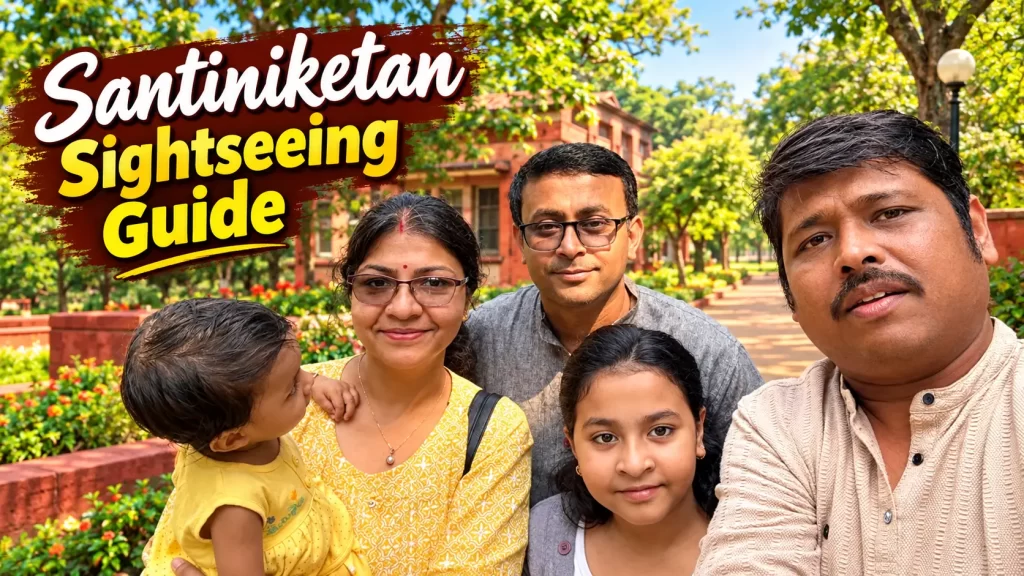
Santiniketan, the “abode of peace” in Bolpur, Birbhum district, is one of the most rewarding short trips from Kolkata. Rabindranath Tagore’s Visva-Bharati University sits here among red-soil lanes, sal groves and heritage buildings. Visitors usually have one question on arrival:
what should we see, and in what order?
This guide covers two sightseeing circuits: the Visva-Bharati campus circuit (24 spots) and the outside sightseeing circuit (12 spots).
A Quick History of Santiniketan
Maharshi Debendranath Tagore founded Santiniketan around the 1860s. He was drawn to the red soil and chhatim trees, built a house here and named it Shantiniketan. The name later came to describe the whole area. His son Rabindranath Tagore built on this foundation and created Visva-Bharati, the university that defines the town today.
Santiniketan Sightseeing at a Glance
| Circuit | Number of spots | Best for |
|---|---|---|
| Visva-Bharati University campus | 24 | History, art, architecture, Tagore heritage |
| Outside sightseeing | 12 | Landscapes, crafts, temples, village life |
Entry fees: The Santiniketan heritage complex has no entry tickets. Only the Rabindra Bhavana museum, which includes Santiniketan Griha, requires one.
Circuit 1: Visva-Bharati Campus (24 Places)
Heritage Core of the Ashram
1. Santiniketan Griha (Santiniketan Bari)
Debendranath Tagore built this house in 1863, and the ashram grew from it. It is now part of the Rabindra Bhavana museum complex.
2. Chhatimtala
Tradition holds that Debendranath meditated under the chhatim (saptaparni) trees here. It remains the spiritual symbol of the ashram, and special prayers are held here during Poush Utsav on 7 Poush.
3. Upasana Mandir (Glass Temple)
Built in 1891, this prayer hall is known for its Belgian glass, chandeliers and patterned glass walls. Worship here is formless, without idols, in the Brahmo tradition. Weekly prayers are held on Wednesday mornings. Remove your shoes and keep silent inside.
4. Pantha Shala
A heritage rest house for visitors and travellers within the old ashram area.
5. Talodhwaj (Tala Dhwaja)
A thatched-roof mud hut that forms part of the Santiniketan heritage complex.
6. Dwijobiram (Dwija Viram)
Another listed structure in the heritage complex, set amid old ashram greenery.
7. Rabindra Bhavana
The museum and research archive dedicated to Tagore, holding manuscripts, letters, paintings and personal belongings. It is next to the Uttarayan complex where Tagore lived for many years. This is the one stop where you need a ticket, so check its weekly closing day before visiting.
8. Tinpahar
A shaded heritage-listed spot, recognisable by the huge banyan trees in the area.
Fairgrounds and Open Spaces
9. Melar Math and 10. Old Melar Math
These are the grounds associated with the famous Poush Mela, which began in 1894 and is held around 7 Poush (December). The venue arrangements have changed in recent years, so confirm where the fair is held if you plan your trip around it. At other times of year these are quiet open fields.
Learning and Administration
11. Central Library
Visva-Bharati’s main library. Access for visitors may require permission.
12. Central Office
The administrative building of the university. It is worth a photograph for its architecture.
13. Hindi Bhavana
Founded in 1939, this institute is a protected heritage area, and notices at the entrance restrict motor vehicles and photography. It is known for the mural work of Benode Behari Mukherjee.
14. Lipika and 15. Ananda Pathshala
Campus landmarks on the usual visitor route. Ask locals or university staff for current status and visiting rules.
Art, Music and Performance
16. Kala Bhavana
Founded in 1919, this is one of India’s most respected art institutions. Nandalal Bose, Ramkinkar Baij and Benode Behari Mukherjee shaped its identity and, through it, modern Indian art.
17. Nandan Art Gallery
The gallery and museum space associated with Kala Bhavana. Opening hours vary, so check before you go.
18. Sangit Bhavana
The institute for music and dance, where Rabindra Sangeet and several dance forms are taught.
19. Natyaghar
The campus theatre, used for plays and dance-drama productions.
20. Sculptures of Ramkinkar Baij
Open-air sculptures by Ramkinkar Baij, a pioneer of modern Indian sculpture. His best-known works here include Santhal Family and Mill Call, which are among the most photographed attractions in Santiniketan.
Houses and Other Campus Stops
21. House of Nandalal Bose
The residence of Nandalal Bose, the legendary artist and teacher at Kala Bhavana.
22. Nandan Sadan Boys’ Hostel
A residential hostel on the usual campus route.
23. House of Amartya Sen (Pratichi)
Nobel laureate Amartya Sen was born in Santiniketan in 1933 and received the Nobel Prize in Economics in 1998. This is a private residence, so view it from outside.
24. Economic Research Centre
A Visva-Bharati research facility in the economics field, on the usual campus route.
Circuit 2: Outside Sightseeing (12 Places)
1. Kopai River
The small river that flows near Santiniketan appears often in Tagore’s writing and in local culture. The riverbank is a calm place to spend the late afternoon.
2. Kankalitala Temple
A well-known Shakti Peeth in Birbhum, set on the bank of the Kopai. According to tradition, the goddess Sati’s bone (kankal) fell here. It is an active place of worship, so dress modestly.
3. Prakriti Bhavana (Nature Art Museum)
An eco-themed art space marked by a decorative entrance gate. Check opening hours locally.
4. Palasbuni
A village area known for traditional mud houses and a rural setting, suited to anyone who wants a glimpse of village life.
5. Khoai
The red-soil badlands, shaped by erosion, are one of Santiniketan’s signature landscapes. On Saturday afternoons, the Sonajhuri Khoai Haat brings in stalls of handicrafts, jewellery, textiles and local products, and often Baul musicians. Bargaining is normal.
6. Amar Kutir
Santiniketan has a well-known handicraft centre of this name, famous for leather goods and batik. Visitors can buy handmade local artefacts there. There is a small river nearby, and a restaurant inside the leather workshop. inditalesindianvagabond
7. Srijani Shilpagram
Srijani Shilpagram is the cultural village of the Eastern Zonal Cultural Centre, on the Santiniketan–Sriniketan Road. It covers about 26 bighas and has nine museums built as traditional huts from Assam, Bihar, Jharkhand, Manipur, Odisha, Sikkim, Tripura, West Bengal and the Andaman and Nicobar Islands, with over 1,000 artefacts. A full visit takes roughly two hours, no guide is needed, and nearby stalls sell regional textiles and handicrafts. airbnbwheelsonourfeet
8. Salbagan
A tidy plantation of sal trees, a popular stop for photography and quiet walks.
9. Deer Park
A deer park near Ballavpur where spotted deer (chital) can be seen in a forest setting. It is a good option with children, and early morning or late afternoon is best for sightings.
10. Buddha Statue
This site was built by the Santiniketan Ambedkar Buddhist Welfare Mission. The large seated statue and decorated base make a peaceful stop. indianvagabond
11. Bangladesh Bhavana
A modern cultural building on the Visva-Bharati campus symbolising India–Bangladesh cultural ties. It was inaugurated in 2018. Check visiting hours beforehand.
12. Surul Zamindar Bari (Surul Rajbari)
The Surul Sarkar Bari dates to the 1750s and was built by Srinivas Sarkar, who made his fortune supplying sails for ships. The village also has temples with fine terracotta carvings, and the family has held Durga Puja here for roughly 290 years. Surul lies next to Visva-Bharati and is about 5 km from Bolpur railway station. lbbwikipedia
Santiniketan Travel Tips
- Best time to visit: October to March, when the weather is pleasant. Poush Mela time (December) is very crowded, so book accommodation early.
- Best day for Khoai: Saturday afternoon, for the Sonajhuri haat.
- How to plan one day: Do the campus circuit in the morning, then Srijani Shilpagram and Khoai in the afternoon, finishing at Kopai or Sonajhuri forest at sunset.
- How to reach: Bolpur Santiniketan railway station is the nearest railhead, with regular trains from Kolkata (Howrah and Sealdah).
- Rules: Follow the signboards in heritage areas. Vehicle entry and photography can be restricted.
- What to carry: A hat, water, sunscreen and comfortable shoes, as the red-soil lanes get dusty.
Frequently Asked Questions
How many places can I see in Santiniketan in one day?
You can cover the 24 campus stops in a morning. Adding the 12 outside stops takes most of a full day.
Is there an entry fee for Visva-Bharati campus?
The heritage complex has no entry tickets, but Rabindra Bhavana museum charges for entry.
When is the Khoai market held?
The Sonajhuri Khoai Haat is held on Saturday afternoons.
Which is the most important temple near Santiniketan?
Kankalitala, a Shakti Peeth on the Kopai river, is the best-known.
Is Santiniketan good for a weekend trip from Kolkata?
Yes. It is reachable by train in about two to three hours and suits both a day trip and an overnight stay.
Conclusion:
From the glass walls of Upasana Mandir to the red cliffs of Khoai and the terracotta temples of Surul, Santiniketan rewards slow travel. Use the 24-spot campus circuit for history and art, then the 12-spot outside circuit for landscapes, crafts and village life.