
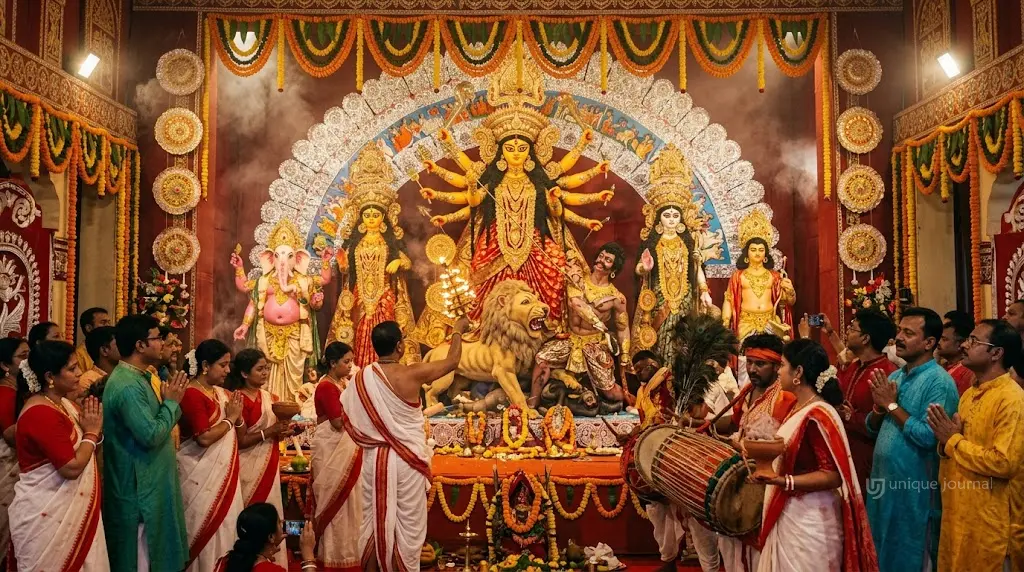
Every autumn, Bengal changes. The air feels lighter, white kash flowers sway by the roadside, and the sound of the dhak (a large drum) starts to drift through the streets. Durga Puja is here. It is a festival, a family reunion, an art show and a five-day street party, all in one.
1. When and why did it all begin?
Nobody can name the exact day the first Durga Puja was held, so it helps to look at the story in three layers.
The myth. In the Devi Mahatmya (also called the Chandi), the buffalo-demon Mahishasura becomes so powerful that even the gods cannot stop him. They pool their energy, and from it the goddess Durga appears with ten arms, each holding a divine weapon. After a great battle she defeats him. The festival celebrates this victory of good over evil.
The Ramayana twist. Spring is the traditional season for worshipping the goddess. But before his battle with Ravana, Lord Rama is said to have woken Durga in autumn, when the gods are believed to be asleep. This “untimely awakening” is called Akal Bodhon, and it is why Bengal celebrates in autumn.
The history. Historians believe that from around the 16th century, wealthy landlords and royal families across Bengal began holding grand Durga Pujas at home. Malda and Dinajpur are often named among the early examples. In 1790, twelve friends in Guptipara, Hooghly, pooled money to hold a puja for the whole neighbourhood. This was the first baroyari (“twelve friends”) puja, the ancestor of today’s community pujas.
Why do Bengalis love it so much? For many, Durga is not only a warrior goddess. She is Uma, the daughter who visits her parents’ home once a year with her four children: Lakshmi, Saraswati, Kartik and Ganesh. That makes the festival feel like a family homecoming. Most probably, in December 2021, UNESCO added Kolkata’s Durga Puja to its list of Intangible Cultural Heritage of Humanity.
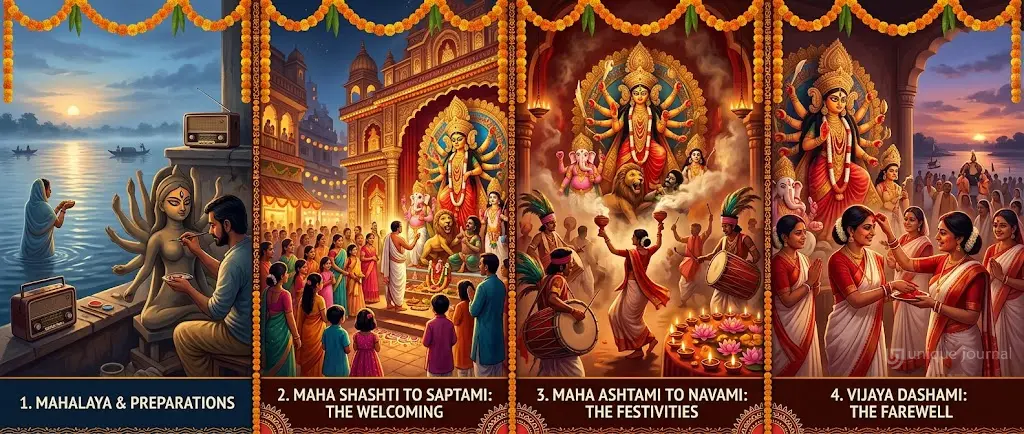
2. The festival, day by day
Mahalaya: the invitation. This day ends the fortnight of remembering ancestors, when families offer water in their memory. Before sunrise, many Bengalis tune in to the radio broadcast Mahishasuramardini, with Birendra Krishna Bhadra’s unforgettable voice. In Kumortuli, the potters’ quarter of Kolkata, artists paint the goddess’s eyes on the idols. It is called chokkhu daan, the “gift of sight”.
Panchami: the countdown. The idols are almost ready, the pandals (decorated puja pavilions) are nearly done, and the shopping crowds are at their peak.
Shashthi: the welcome. The goddess is formally invited through rituals called Bodhon, Amantran and Adhivas. In the evening, the cloth covering the idol’s face is lifted, and the festival begins.
Saptami: the nine plants. In the morning, a bundle of nine plants, including banana, turmeric and rice paddy, is bathed in the river, dressed in a sari and placed beside Ganesh. This is the Nabapatrika, popularly called the “Kola Bou” (banana bride). It symbolises nature, the harvest and the goddess’s life-giving energy. The idol is then ritually brought to life.
Ashtami: the big day. Many people consider this the heart of the festival. Thousands line up in the morning to offer pushpanjali (flowers) to the goddess. In some places a young girl is worshipped as the goddess herself in Kumari Puja. At the meeting point of Ashtami and Navami comes the Sandhi Puja, a sacred 48-minute ritual with 108 lamps and 108 lotus flowers. Tradition says this is the moment Durga defeated the demons Chanda and Munda.
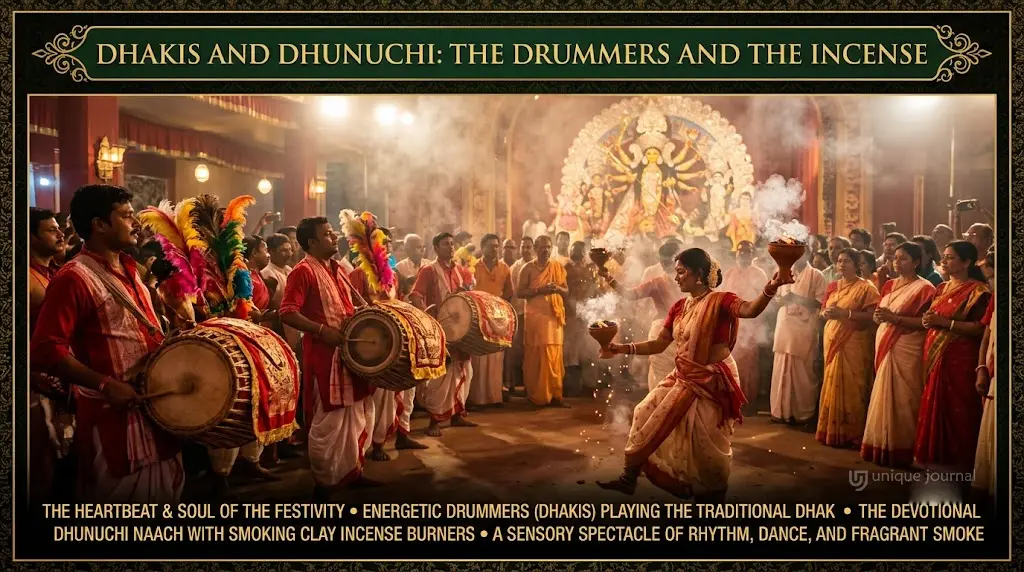
Navami: the grand finale. The last full day of worship has a big aarti, dhunuchi dancing (dancing with smoking incense pots) and the beat of the dhak. Many pujas once included animal sacrifice. Today many offer symbolic substitutes such as sugarcane or ash gourd.
Dashami (Bijoya): the farewell. Married women place vermilion on the goddess’s forehead and then smear it on each other in Sindoor Khela, with laughter and tears. Then the idols are carried to the river for immersion. That evening, everyone says Shubho Bijoya, touches the elders’ feet, hugs and eats sweets.
3. Some of Bengal's oldest pujas
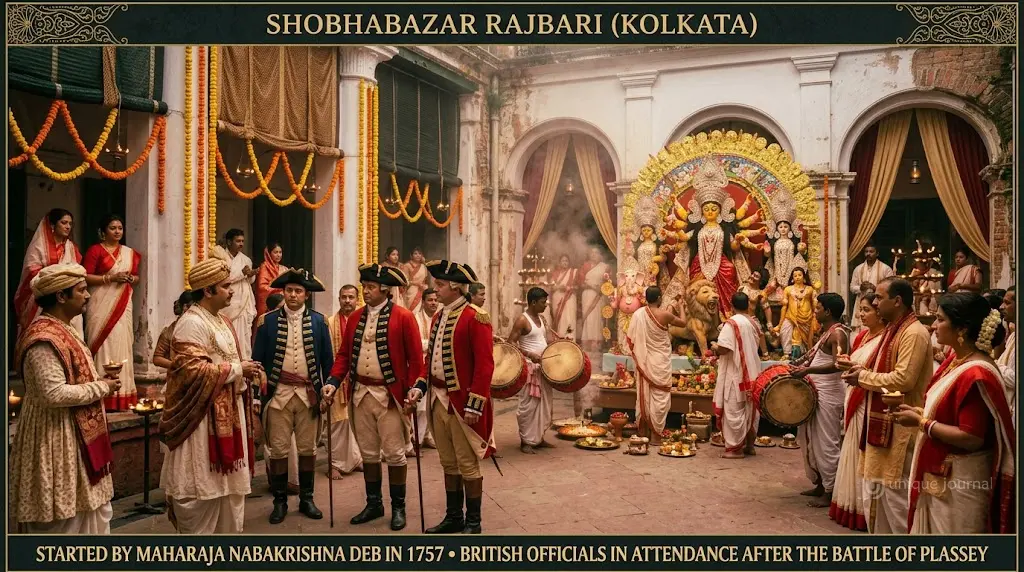

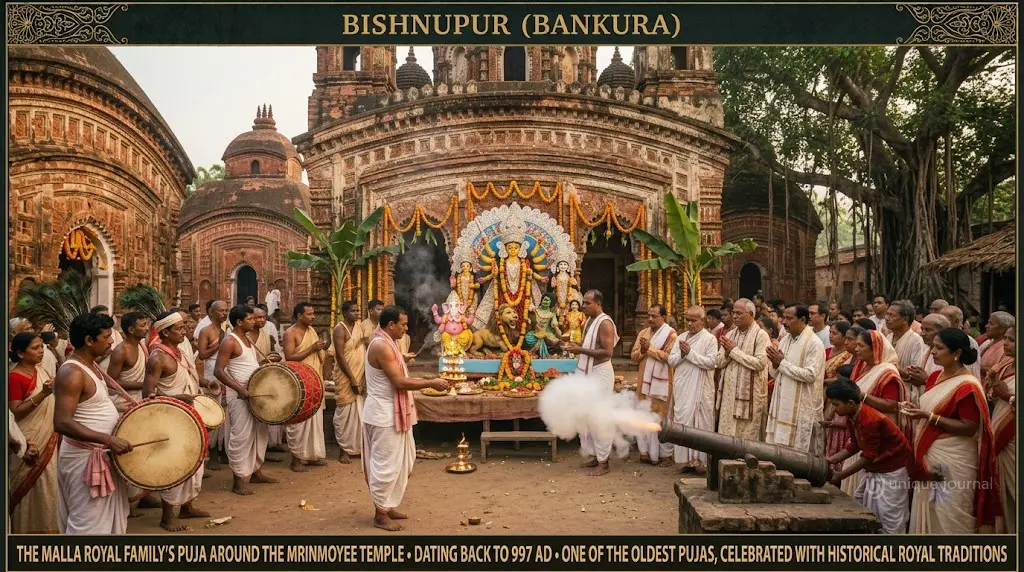
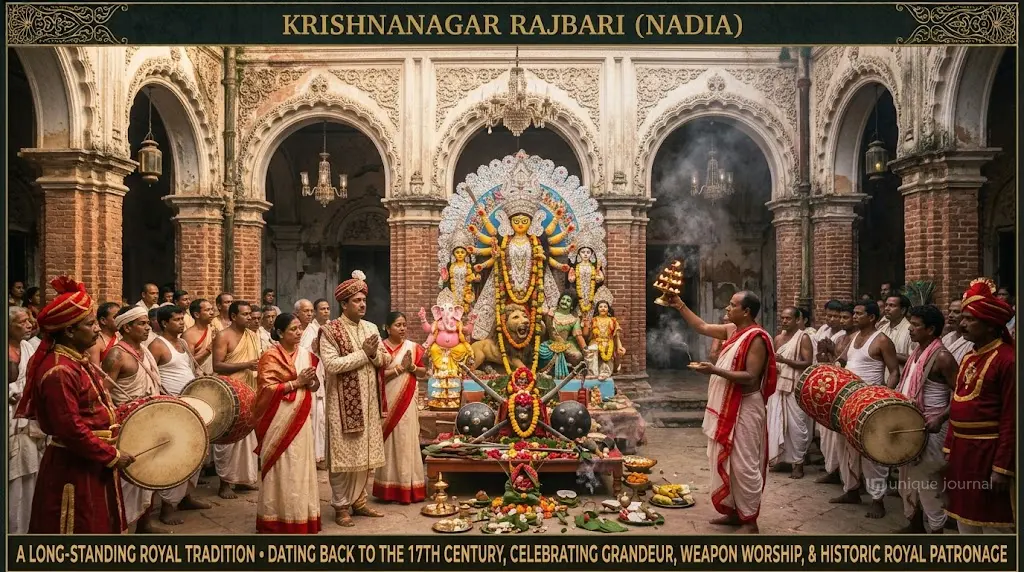
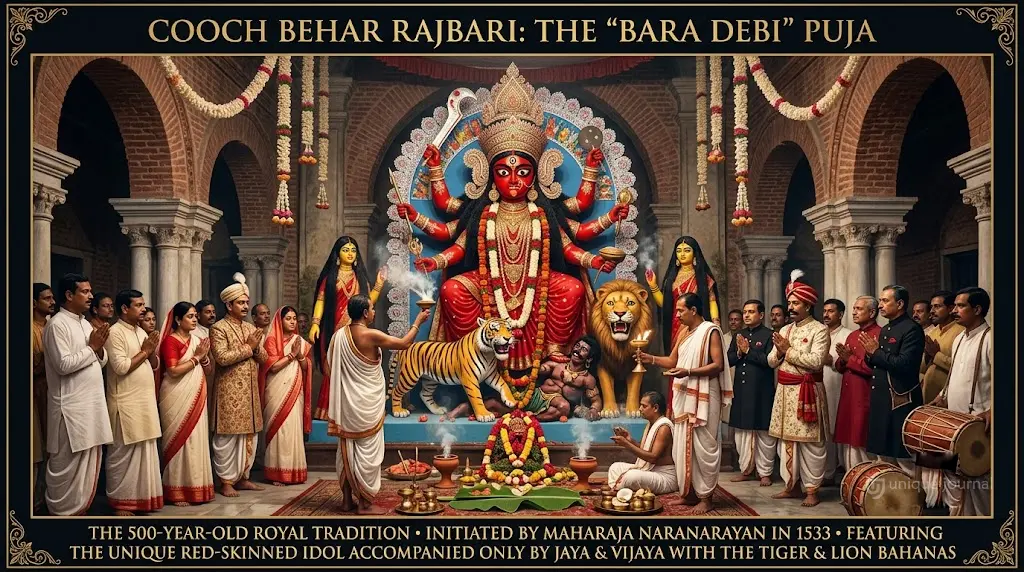
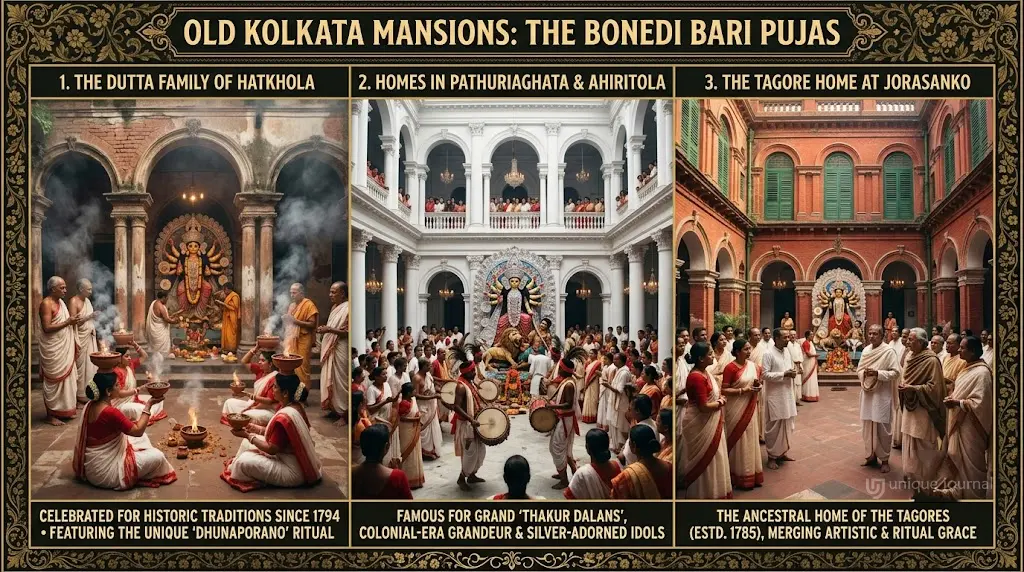
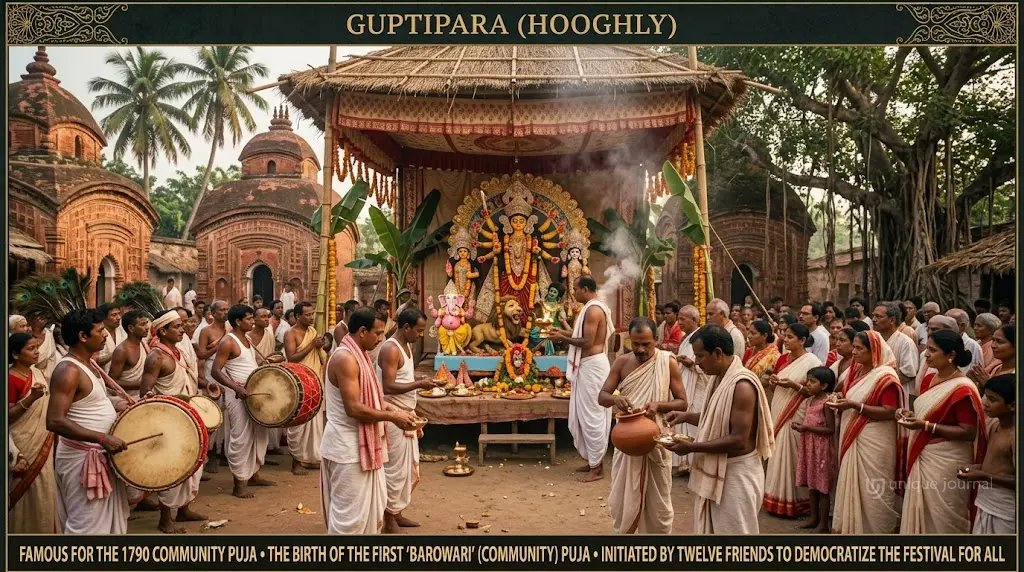
Many of these dates come from family tradition rather than written records, so read them as “said to have begun”.
- Sabarna Roy Choudhury family (Barisha/Behala, Kolkata): said to date from 1610, one of the oldest in the city.
- Shobhabazar Rajbari (Kolkata): started by Maharaja Nabakrishna Deb in 1757, with a famous story about British officials attending after the Battle of Plassey.
- Janbazar Rajbari (Kolkata): the puja of Rani Rashmoni’s family.
- Old Kolkata mansions: the Dutta family of Hatkhola, and homes in Pathuriaghata and Ahiritola, as well as the Tagore home at Jorasanko.
- Guptipara (Hooghly): famous for the 1790 community puja.
- Bishnupur (Bankura): the Malla royal family’s puja around the Mrinmoyee temple, said by local tradition to be nearly a thousand years old.
- Krishnanagar Rajbari (Nadia): a long-standing royal tradition.
- Cooch Behar Rajbari: the “Bara Debi” puja.
4. When is Durga Puja each year?
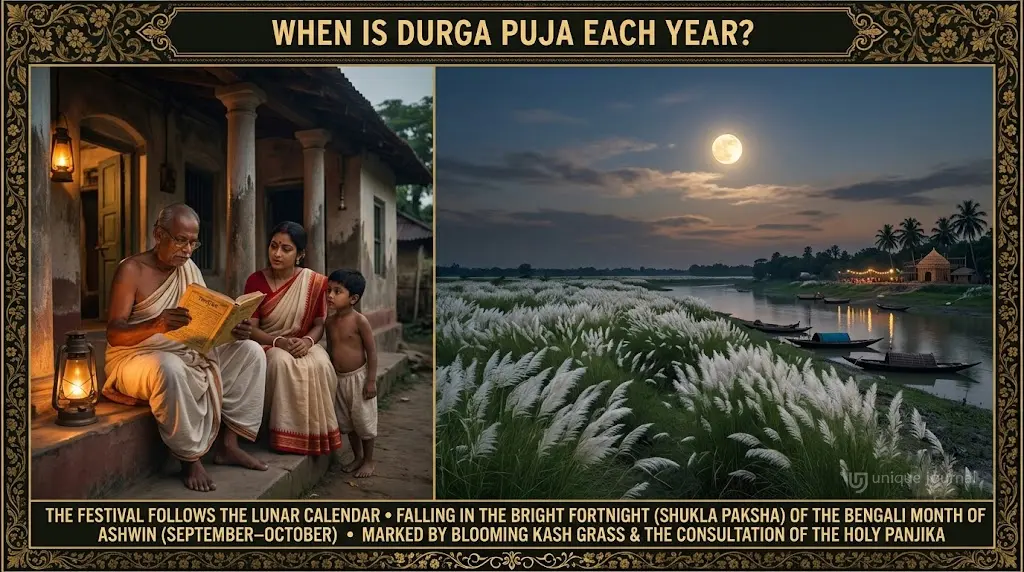
The festival follows the lunar calendar. It falls in the bright fortnight of the Bengali month of Ashwin, from Shashthi to Dashami, and the new moon before it is Mahalaya. The lunar calendar doesn’t line up neatly with the solar year, so the dates move around, sometimes to late September and sometimes to late October. Most Bengali households follow a panjika (almanac), such as Bishuddha Siddhanta or Gupta Press.
A few extras to enjoy during Durga Puja
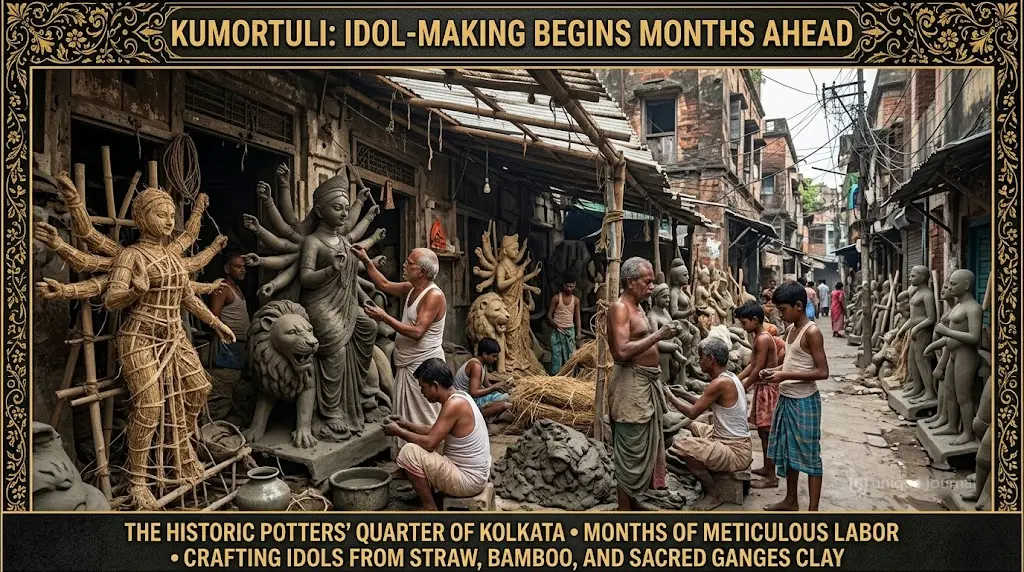
- Kumortuli: idol-making begins months ahead. Tradition holds that a bit of soil from a courtesan’s doorstep goes into the clay, a symbol of respect for people society often pushes aside.
- Dhakis and dhunuchi: the drummers and the incense-pot dancers make the sound and the smell of puja.
- Theme pujas: since the 1990s, Kolkata’s pandals have become creative art installations, from replica palaces to pandals made of bamboo, clay or even recycled materials.
- Pujo sankhya: special festival magazines and new clothes are a must in every Bengali household.
- Bhog: the temple-style khichuri, mixed vegetable curry and chutney served on Ashtami and Navami taste better than anything else all year.
- Around the world: the Dhakeshwari temple in Dhaka is the heart of the festival in Bangladesh, and Bengalis abroad hold pujas from London to New York.
That’s the story of Durga Puja: a goddess who defeats a demon, a daughter who comes home, and a city that stays up all night to welcome her. Shubho Pujo!

