
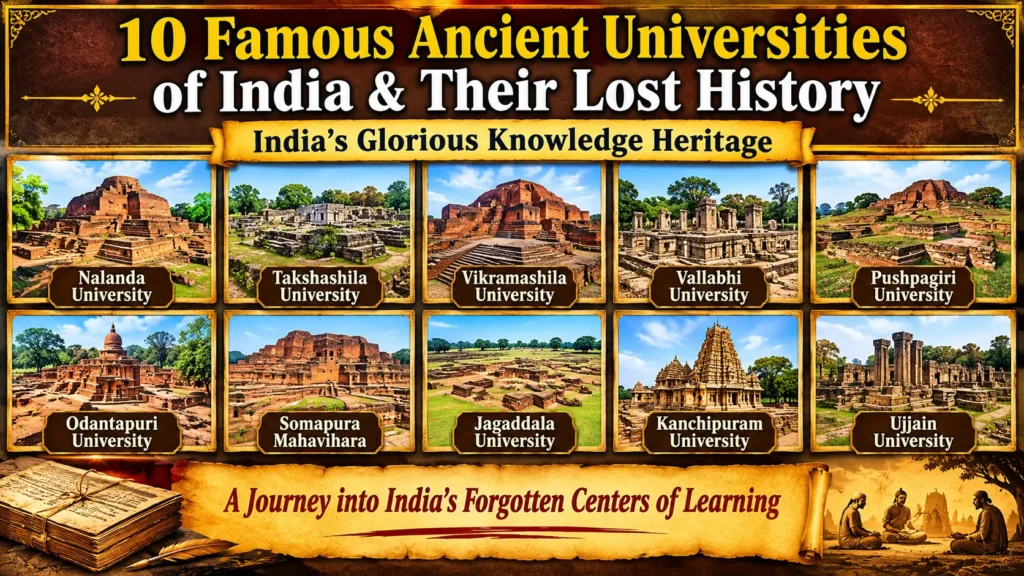
There was a time when anyone on Earth searching for the light of knowledge looked toward India without a second thought. Today, the world marvels at Oxford, Cambridge, and Harvard; yet centuries before their foundations were even laid, the Indian subcontinent was home to the world’s earliest residential universities. Crossing treacherous mountains and vast deserts, scholars from China, Tibet, Korea, Greece, and Central Asia journeyed here solely to quench their thirst for learning.
Today, most of these magnificent centers of learning survive only as silent ruins of brick and stone. Yet beneath every crumbling wall lies an extraordinary chapter of human civilization. Let’s turn back the pages of history and walk through these 10 lost temples of knowledge from ancient India.
1. Takshashila: The World’s Oldest Seat of Learning
At a time when much of the world had yet to master the written word, Takshashila (located in present-day Pakistan) was already teaching over 64 disciplines. Flourishing around the 7th century BCE, this ancient university had no rigid syllabus—students chose their own masters and paths of study. Legends who shaped Indian civilization, including the master strategist Chanakya, the Sanskrit grammarian Panini, and the father of Ayurveda, Charaka, were all products of Takshashila.
2. Nalanda: The Great Ocean of Knowledge
Situated in Bihar, Nalanda was the ancient world’s first truly international residential university. Its sprawling campus buzzed with nearly 10,000 students and 2,000 teachers. Its legendary library complex, Dharmaganja, housed over 9 million manuscripts. Historical accounts say that when invaders set fire to this vast repository of wisdom around 1202 CE, the flames burned continuously for three months.
3. Vikramashila: The Golden Age of Tantra and Philosophy
As Nalanda’s glory began to wane, Pala Emperor Dharmapala established Vikramashila University in the 8th century CE in present-day Bhagalpur, Bihar. It quickly rose to become the premier center for Vajrayana Buddhism and philosophy. Bengal’s celebrated scholar Atisha Dipankara Srijnana—who played a pivotal role in spreading Buddhism to Tibet—served as the chief abbot of this illustrious institution.
4. Somapura Mahavihara: Where Architecture Met Wisdom
Standing in Paharpur, in present-day Naogaon district of Bangladesh, Somapura Mahavihara was the crowning pride of ancient Bengal. Founded by King Dharmapala, it was not just a thriving center of scholarship; its monumental, pyramid-like terraced architecture still leaves visitors in awe today as a UNESCO World Heritage Site.
5. Odantapuri: The Inspiration Behind Tibet’s First Monastery
Established in Bihar during the 8th century CE by Gopala, the founder of the Pala dynasty, Odantapuri University gained immense international renown. Its reputation reached so far that Tibet’s very first Buddhist monastery, Samye, was modeled directly after Odantapuri. At its peak, around 12,000 students studied within its walls.
6. Valabhi: The Hub of Economics and Statecraft
Located in Gujarat, Valabhi University stood as a formidable rival to Nalanda. Beyond religious and philosophical studies, Valabhi excelled in practical disciplines such as economics, law, agriculture, and politics. In ancient times, graduates from Valabhi were highly sought after for top administrative posts in royal courts.
7. Jagaddala: The Cradle of Translation and Literature
Founded in the 11th century CE by Pala Emperor Ramapala in present-day Naogaon, Bangladesh, Jagaddala Mahavihara emerged as a vital sanctuary for scholars when other northern Indian universities faced relentless invasions. Countless rare Sanskrit texts were meticulously translated into Tibetan within its quiet halls.
8. Vikrampur: The Ancient Oxford of Bengal
Located in present-day Munshiganj, Bangladesh, Vikrampur Mahavihara was one of the most prosperous centers of education in ancient Bengal. It was not only a renowned seat of scholarship attracting monks and intellectuals from China and Tibet, but also the birthplace of the great scholar Atisha Dipankara Srijnana.
9. Pushpagiri: Silent Scholarship Amidst the Hills
Nestled among the lush green hills of Odisha around the 3rd century CE, Pushpagiri University was a serene bastion of learning. The famous Chinese traveler Xuanzang (Hiuen Tsang) praised this institution vividly in his travelogues. Its expansive campus stretched across the scenic hilltops of Lalitgiri, Udayagiri, and Ratnagiri.
10. Ratnagiri: A Confluence of Art and Intellect
One of the jewels of Odisha’s famous “Diamond Triangle,” Ratnagiri Mahavihara flourished from the 5th to the 13th century CE. It was a distinguished hub for Buddhist philosophy, sculpture, and art. Even today, the intricate stone carvings scattered across its ruins bear silent testimony to the extraordinary craftsmanship of ancient Indian artisans.
Why Did This Golden Era Fade Away?
History’s cruelest irony is that these towering beacons of knowledge were not erased by natural disasters, but by human hands. Repeated invasions by armies from Central and West Asia systematically reduced these great universities to rubble. Millions of priceless manuscripts were consigned to flames, and unarmed teachers and students were mercilessly killed.
Yet, while walls of brick and stone can be shattered, the spirit of knowledge can never truly be destroyed. Stand before the ruins of Nalanda, Takshashila, or Somapura today, and you can almost hear the faint echoes of ancient chants and lively scholarly debates from a thousand years ago. These ruins do more than remind us of a tragic loss—they remind us that we are the inheritors of a civilization that once illuminated the entire world.
Stay Tuned for the Next Part
This is just the beginning of our 10-part special series! In the upcoming posts, we will dive deep into the untold history, curriculum, and fascinating legends of each university. Up first: Takshashila—the world’s oldest seat of learning, where Chanakya and Panini once walked.
Disclaimer: The information presented in this blog is compiled from various historical records and archaeological studies. Differences in scholarly opinions regarding ancient history and timelines are natural. The sole purpose of this article is to provide a general overview of India’s ancient education system and heritage—it is not intended to hurt the sentiments of any individual, community, or religion.

